John Taylor & Paul Reiser (Nice Guys, Redux)


I missed the memo about John Taylor & Paul Reiser.

(The devastatingly handsome John Taylor, whom I wanted to marry when I was 11; and the utterly adorable Paul Reiser, whom I wanted to marry once I wised up a bit.)

My dear childhood friend, Krista, and I were recently plotting to attend an upcoming Duran Duran concert.  Our friendship had been forged in our shared fanaticism for Duran Duran, which dates back to the early 80s.   She loved Simon LeBon with an unfathomable ardour, whereas John Taylor, with his highlighted hair, soulful brown eyes, and pouty lips…he was more my type. 

When we figured out that our schedules weren’t going to jive to attend a show together, I sent Krista this text message:   “Don’t stress…after JT, Paul Reiser was my next true love and his new show also premiers that night.  Stay home with you bebes; we’ll hit it next time!”   Apparently, this message was a bit confusing, as a few days later, Krista sent me this reply: “It has taken me several days to wrap my head around your Paul Reiser thing.  So now I must ask, how does one go from John Taylor to Paul Reiser?!?” 

I presume Krista meant no disrespect to Paul Reiser, but perhaps an explanation is in order.  I talked a bit before about how I had gotten a memo about nice guys from Alanis Morissette.  I apparently got another from Cosmo.  They once ran an article (described to great effect here) which identified that there are two kinds of husbands:  There’s the “boyfriend husband” and the “husband husband.”   These are fairly intuitive categories; the “boyfriend husband” is more of a bad boy, he doesn’t settle easily into domestic life, he keeps you guessing.   The “boyfriend husband” can be pretty exciting, but he can drive you crazy.  Whereas the “husband husband” is more fully committed, a bit more predictable, totally loveable and doesn’t make you nuts.  

When Paul Reiser’s hit show “Mad About You” premiered back in 1992, I remember watching him and Helen Hunt and thinking…”That…that’s what I want…I want a nice guy who loves me and makes me laugh a lot.”  Paul Reiser, as the character of Paul Buchman, was definitely a  “husband husband.”  I’m guessing that John Taylor, who is now a married man these days, is a perfectly good husband.  But I’m also guessing he’s a “boyfriend husband”—a globe-trotting pop star, recovered cocaine addict…yeah, definitely a  “boyfriend husband”.  

So instead of John Taylor, I married Paul Reiser, albeit in a slightly taller, slightly blonder, slightly more gentile incarnation.   He slays me with his silliness and I revel in his goodness. 

(My husband, whom I will not forsake, not even for John Taylor or Paul Reiser)

My “husband husband”  does indeed make me laugh a whole lot, and sorry JT, I love him more than I think I ever could have loved you.   Memo received. 

© 2011 Jamie Walker Ball

Philosophy and….Philosophy


I missed the memo about Philosophy and ….Philosophy.

Like most freshmen at my liberal arts-y college, I took an Introduction to Philosophy course.   The class was hard, but it helped that the professor looked like something out of Body Heat

(Seriously…slap a tweed sport coat on William Hurt and you get the school girl swoon-worthy Dr. Philip Neujahr.  I had a very unorginal crush on him.)

One of Dr. Neujahr’s favorite transitional phrases was/is, “Firm grasp of the obvious? Yes? Yes? Yes?”  It was a cute and reassuring way of checking in throughout his lectures just to make sure he hadn’t left a gaggle of gobsmacked teenagers in his intellectual dust.

But it was an interesting choice of words.  A lot of the ideas we wrestled with started with something obvious and then we were challenged to reconstruct the cerebral scaffolding that supported concepts that really only seemed obvious.  It was trippy. 

I can’t pretend to have been a truly serious student of philosophy, but the coursework I did undertake did help me to appreciate that there’s a lot more to the human experience than meets the eye.  If we’re tired, or lazy, or things are really, really bad, we can function on a pretty animalistic level.  But given our cranial capacity, we’ve got the option of swimming around in the world of ideas.  Sometimes we figure stuff out, and sometimes, we figure out the stuff we haven’t figured out, and that can be good, too. (I know that’s a bit “Bill & Ted“-ish…but when it comes to my own efforts at doing philosophy, that’s all I got.)

Perhaps it was the affection I had for Dr. Neujahr and all the things he taught me that inspired my adoration of the Philosophy line of skin care products and perfumes.  

I’m a sucker for a well-conceived and well-executed branding campaign.  They had me at “Hope in a Jar“. I mean really, what are beauty products about if not hope?  I don’t  know if Philosophy products are the best thing on the market, but I think they’re the most charming.  And when I go about my day wearing a perfume called “Pure Grace,” maybe, just maybe, I’ll be inspired to actually exhibit the characteristic for which the perfume is named. 

Think deeply and smell good while doing it.  Memo received

How to Lighten Up


I missed the memo about  how to lighten up.

My mom likes to say I was “born 30” and I think that’s code for the fact that I am congenitally uptight.  I’m “Type A”, judgmental,  a rule follower, a worrier, a planner…so it’s no surprise that I’m often told to lighten up. 

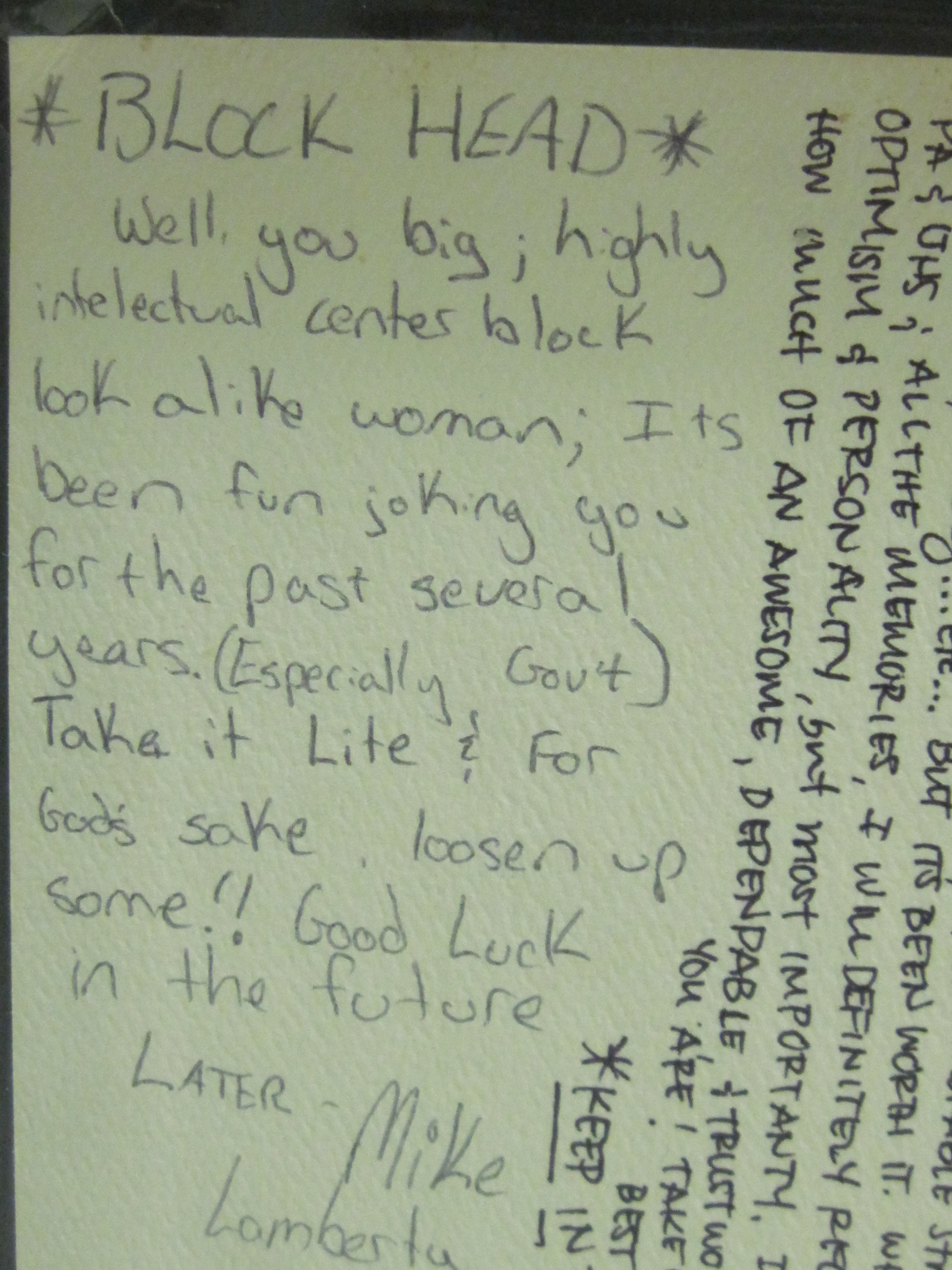
I submit to you Exhibit A, an inscription in my senior year book:

(“Blockhead”…I had forgotten about that…this guy didn’t appreciate my strong jaw and truly exquisite bone structure, but check it out…back in high school, my face was nearly a perfect square…this was my serious debate team face…)

I used to bristle at the suggestion that I ought  to lighten up.   Telling someone to relax when they’re obviously having a hard time relaxing usually has the effect of making them even less relaxed.  Isn’t it funny how that works? 

But these days, I try to take the suggestion to heart.  I’m starting to understand that when I start to get rigid, it’s usually because I’m scared, anxious, or just really, really annoyed.  The world of rules and structure is my safe zone, and I retreat to it when I’m having a hard time coping with anxiety and uncertainty.  As an attorney, this is awesome.  When I’m stressed out about a case, I can go look up a statute and figure out what the rules are, and the rules make me feel a little more grounded. 

In real life, however, there isn’t a universally applicable rule book.  Some might say go look in a Bible, and that’s of some comfort, but the Bible unfortunately did not contemplate a rule for how I should conduct myself when my husband forgets to push down that little doohickey that makes the water come out of the faucet instead of the shower head and I get doused with cold water…again.  I suppose there’s something in The Good Book about husbands and wives honoring each other, but that’s not a complete prescription for how irritated I’m allowed to be in this situation. 

The thing I’m trying to learn is that when I’m asked to lighten up, it doesn’t mean that I’m not right, as I am  just about always right, just ask me.  Rather, it means that I need to keep some perspective.  Right at what cost?  When I tense up, dig in, and fight about something inconsequential, what good is served?  I talked before about my hair and the trouble it causes me, so in the aforementioned shower scenario, it kinda is a big deal as getting my hair unintentionally wet can seriously ruin my day.  OK…there I go again…”ruin my day”?  Really?  A little perspective, please. 

I still hope my husband gets the memo about pushing down that  doohickey, but if he doesn’t…memo received. 

 © 2011 Jamie Walker Ball

Dessert & Upward Mobility


I missed the memo about dessert and upward mobility.

When I was in college, the young woman who lived in the adjoining room, let’s call her M, was a real sweetheart.  She came from a good family, and they were a little protective, so they came to visit often.  When her folks came to town, M could round up her friends and M’s parents would treat the gaggle of us to a nice dinner at a restaurant near campus.  This was wonderfully generous in and of itself, but it gets better. 

I had the good fortune of being invited along on one of these dinners and as the extensive dessert menu was presented, M’s father took a quick look and decisively said, “Just bring us one of everything and we’ll pass them around.”  As a great lover of desserts, I was absolutely delighted by the largesse of this gesture. 

I grew up in a working class-ish family and when I went to college, I started catching glimpses of how more “privileged” kids had grown up.  Part of me recoiled at the idea of having a housekeeper or spending money on a luxury car or a designer purse…these kind of things were a little offensive to my slightly socialistic sensibilities.  I convinced myself  that people with money were soft and self-indulgent….whereas people without money were sharp and resourceful.  At the time, this was probably a healthy bit of defensive thinking, I think, but it threw up some roadblocks in the way I connected with some of my more well-off peers and it limited my imagination of how my life might ultimately be different from my parents’. 

But when M’s dad ordered all those desserts for a giggling gaggle of co-eds, I thought, “OK, wow, this is why it’s good to have some money.”  Money can buy stuff, but it also buys experiences, and I think that was the real lesson for me.  M’s dad wasn’t trying to be a big shot, he just wanted his daughter’s friends to have some fun and enjoy a fantastic end to their meal.  And he didn’t seem to worry about how much it cost. 

Until I finish paying off law school, I really won’t have a pot to piss in, so for now I’m holding pretty tenaciously to most of my frugal, working class sensibilities.  But theoretically, I’ll be ascending the socio-economic ladder a bit in the coming years.  I’m no longer so afraid that having a bit of money will make me soft or self-indulgent.   Even if I have some money, I can still be liberal.  I can still be low-key.  I can still be me.  No one is going to force me to buy a  Bentley or a Prada handbag.  But maybe I will buy all the desserts.  And pass them around.  Memo received. 

© 2011 Jamie Walker Ball

My Weird Brain & Juliette Binoche


I missed the memo about my weird brain and Juliette Binoche.

My husband and I were recently talking about our shared grief over Steve Carell’s imminent departure from “The Office“.  We were speculating about what path his career might next take, and I commented that I hoped he would do more roles that weren’t just silly, but also showed off his sweet side.  Here’s a rough transcript of the conversation:

Me:            You know, like that movie he did with Juliette Binoche.

Ryan:       Steve Carell was in a movie with Juliette Binoche?  When?

Me:            I don’t know, but it was good, and it had something to do with pancakes. 

And then I let my fingers do the Googling and in a few seconds, this image popped up:

Somehow, my brain had filed “Dan in Real Life” and cross-referenced it under the categories of “Steve Carell”, “Juliette Binoche” and “Pancakes”.  Being easily amused is one of my better qualities, and I have to admit, this cracked me up. 

And then I geeked out a little and started thinking about the idea of metacognition.  I first got the memo about metacognition in one of my college psychology courses.  Metacognition describes  “a learners’ automatic awareness of their own knowledge and their ability to understand, control, and manipulate their own cognitive processes.”  Wait…what?  Seriously, it blew my mind, too, when I first thought about it.   But once in a while, you can observe your brain at work, and then it’s kind of fun to appreciate that you have all sorts of weird and wonderful strategies for storing information so that it’s available and useful to you when you need it.  Being mindful of these strategies and using them to your advantage can make you a hit at cocktail parties and a one-time Jeopardy! loser, much like myself. 

Clearly, my brain likes to have visual associations for stuff.  When I attempted to compute “Steve Carell + Juliette Binoche”  the result was a vivid image of pancakes in my mind.  So maybe, the next time I’m trying to remember something important, I’ll make a teensy extra effort to connect a meaningful visual so I can increase my processing speed just a bit. 

And just a word or two about Juliette Binoche…

I got the memo about Juliette Binoche when I saw “The Unbearable Lightness of Being” for the first time  (oh man, so many memos…)  Seriously, is there a more luminous creature in the world? I just love her French face. She’s very beautiful, but I find that there is something awesomely awkward about her.  Ms. Binoche helped me to understand that being perfect isn’t the end all be all of attractiveness; being imperfect and interesting is so much sexier than being perfect.  At least that’s what I keep telling myself. 

I majored in psychology and minored in French (and one of my upper level electives was “Great French Actress and Their Roles”  how cool is that?) so I feel like this blog post reflects that I’m getting some serious mileage out of that fancy liberal arts education (that I am still paying for…)  Memo received.

Ditching Cable TV


I missed the memo about ditching cable TV.

Let’s get something quite clear from the outset.  I love TV.  I am kind of a couch potato, and for better or worse, my son is kind of a couch tater tot.  Sure, we go outside and play, but on the evenings that we’re home, we’re often watching TV. I make no apologies for this. 

However, in keeping with the zeitgeist,  my husband and I have been feeling the need to streamline things a bit.  Figuring out how to spend less money and simplify your life seems like a rational response to budgetary restraints and burgeoning chaos, right? Right.  But give up our cable?  Should we? Could we?  Yes we can. 

We ditched our cable a couple of weeks ago and there’s been no looking back.  We have not, however, given up watching TV.  We got a miraculous little gizmo called a Roku, and with the Roku and a wireless router, we can watch all the web-based TV we want.  We were already paying for Netflix, which has more movies and TV shows than I could ever watch in this life time.  And now we subscribe to Hulu-Plus, which allows us to watch just about all the recent broadcast stuff just about whenever we want. And we’ve got a digital antenna so if we need to tune in for live local news, no problem. 

For someone like me who is really TV-philic and slightly techno-phobic, cutting the cable cord and embracing this new technology was a little bit scary.  Mercifully, on this journey toward a cable-free existence,  I’ve had a great sherpa in my adorable husband.  He did the heavy lifting in researching our new set up and getting it up and running.  And now it’s better living through fiber optics. 

In addition to being so much cheaper than cable, watching TV this way has made it a more mindful experience.  Instead of there being (300 and) 57 channels and Nothin’ On, there’s now a self-selected menu of options that I’ve tailored to my own interests and tastes.  Actually, most of the options are tailored to my son’s tastes, and when you go searching for dinosaur-themed programming on Netflix, you will find an embarrassment of riches. 

It’s been really lovely to settle in for the evening and actually take stock of my mood and my energy level and really think about what it is that I feel like watching.  No more mindless channel surfing.  And yes, sometimes I have to admit to myself that I don’t feel like watching anything and I actually turn the TV off.  Wow.   Memo received. 

 © 2011 Jamie Walker Ball
Bagels


I missed the memo about bagels.

Growing up in a pretty WASPy corner of the South, I think I was in my teen years before I even knew what a bagel was.  Judging by its round shape, the hole in the middle, and the time of day at which it was served, I was expecting something like a donut.  I was bitterly disappointed.  Because I was expecting sweet and airy and I got dense and chewy, I resented the bagel for not being what I expected it to be.

Since then, I’ve come to my senses.  Bagels are awesome.  Toasted, untoasted, embellished or plain, or purely as a delivery system for cream cheese.  Yum. 

It might seem kind of banal to be ruminating about bagels, but that first experience has always stuck with me.  It still strikes me as funny (both “ha ha” and weird) that instead of appreciating the bagel for what it was, I was disappointed because it wasn’t what I thought it would be.  I think I remember the bagel incident because it was just so silly, but I wonder how often I make these misjudgments when the stakes are higher? 

What I’m getting at here is that expectations can be a bit of a trap, so I need to tread carefully to avoid being ensnared.  I like to plan, I like to have expectations, but my expectations can trick me into needlessly feeling disappointment.  Example…I remember seeing the rough cut of my wedding video and there’s a shot of me waiting to go down the aisle and I am clearly seen making an angry face and saying a word unbefitting a bride simply because my aisle runner hadn’t been laid out the way I expected.  So stupid to let a little deviation from my expectations take me out of the happiness of the day. 

As donuts go, bagels are terrible, but as bagels, they’re outstanding.  Sometimes, letting go of expectations is the key to happiness in both life and in brunch.   I’ll have this memo with a schmear of cream cheese, tomatoes, and turkey bacon please.  Memo received. 

 © 2011 Jamie Walker Ball
The Tragedy of the Commons


I missed the memo about the Tragedy of the Commons.

The Tragedy of the Commons refers to the phenomenon where there is a communal resource that is sustainable only if everyone using it takes only their share, but where each person uses more than their share because they think their extra bit of consumption won’t make a difference. You can see where things start getting effed up if everyone operates under this assumption. 

It’s not surprising that the most well-known article about this phenomenon was penned by an ecologist, Garrett Hardin.  In about 10 seconds, you could probably think of 10 examples of how our individual short-sightedness has led to overuse, depletion, or extinction in our natural world.    It’s an interesting quirk in human thinking that we can convince ourselves that our little contributions to big problems don’t make a difference.  But all of those little contributions are what create the big problems, capice?

In recent days, I’ve been thinking about the flip side of the Tragedy of the Commons.  Where there’s a incomprehensibly big problem out there in the world, it can sometimes be hard to see how my teensy tiny contribution to the solution could possibly help.  But what I fail to consider is the collective effect of my teensy tiny contribution, and yours, and that guy’s, and so on. 

Even when I consider my teensy tiny contribution to a solution by itself, I just can’t be cynical or hopeless. I just can’t.  I have to believe that I can help, even if it’s  just a little.  My friend Rachel recently reminded me about “The Starfish Story.”  You know you know it…the guy’s walking along the beach as the tide is going out, tossing starfish back into the surf.  A passerby observes this and comments that there are miles of beach and countless starfish, so he couldn’t possibly make a difference. The guy picks up another starfish and tosses it into the water and says, “I made a difference for that one.”

You probably see where I’m going with all of this.  Today I was sad, but not entirely surprised, to read this article  which reported that fundraising for the recovery effort in Japan is off to a slow start.  The theory is that because Japan is perceived as such a strong country, they don’t need as much help.  But that’s crap, isn’t it?  Think about when a football player takes a hit and gets knocked on his ass.  This guy’s a  dazzlingly capable athlete who could probably levitate off the field just by flexing his glutes.  All the same, one of his fellow players will extend a hand and pull him up.  Because it’s the gracious, right thing to do. 

I wonder if people are also ambivalent about  giving  because they don’t know how their small contributions could make a difference in light of the scale of  the disaster.  But when someone gets knocked down, you pick them back up.   And if we all pull together, we get Japan back on its feet.  Memo received.

The Bystander Effect


I missed the memo about The Bystander Effect.

I think I was in my “Introduction to Psychology” class in high school when I first heard about the notorious murder of Kitty Genovese.

 In 1964, Ms. Genovese was stabbed to death in front of her apartment building in New York.  Police later learned that as many as 38 of her neighbors either saw or heard the attack, but only one called the police, and this call came too late to save her life. 

Like anyone, I was mystified as to how it could be that no one came to her aid.  She must have been literally screaming bloody murder and no one helped her.  Aren’t we supposed to be safer when lots of people are around?  Turns out, we’re not. 

Despite what your mother may have told you about driving along deserted roads, you’re statistically much better off getting a flat tire on a lonely stretch of highway than on a busy city street.  Counterintuitive and trippy, isn’t it?  But think about it…on a busy street, cars zip by, and everyone can convince themselves that someone else will stop to help, whereas, on the lonely road, if another motorist happens upon you, he or she will have some understanding that he or she is your only hope, so the sense of personal responsibility is greater.

The Bystander Effect describes the phenomenon that occurs when a group of people observe some kind of crisis.  When each person knows that others are also aware of the crisis, the sense of personal responsibility becomes diffuse.  Everyone somehow thinks that someone else will take the necessary action, and if everyone thinks that, no one acts. 

About 100 years ago when I was first getting CPR training, I got another memo on The Bystander Effect.  The trainer reminded us that upon coming upon a person in respiratory distress, the first thing we needed to do was to summon paramedics.  But the trainer made this key point:  Don’t say, “Someone call 911!”  Instead, identify a specific person, even if you don’t know them:  “Hey, you in the blue shirt!  Call 911!”  You make Mr. Blueshirt personally responsible for the call so he can’t assume that someone else will do it for him. 

In the last couple of days, we’ve all been awed by the destruction we’re seeing in Japan.  It’s terrible  beyond any words to describe it.  While Japan is a strong country of resourceful and resilient people, it needs help.    Don’t assume that everyone else will contribute to relief efforts. I entreat you, yes YOU, the one sitting at your computer reading these words, to do what you can.   The American Red Cross even makes it super easy…you can text the word “REDCROSS” to 90999 to donate $10 which will be billed to your cell phone account.  Text sent and memo received.

Zen and the Art of Potty Training


I missed the memo about Zen and the art of potty training.

Please forgive this foray into the scatological, but my son is nearly 3 so it’s about that time.  When I recently won a free copy of the e-book, “Oh Crap! Potty Training”  I took it as a sign from the gods that we needed to get on the potty training trolley.

The technique recommended by the author makes a lot of intuitive sense, but it’s hard.  It takes a lot of parental focus and what is the theme of modern life, if not distraction?  To help ensure my son’s best start in this potty training adventure, I couldn’t really let him out of my sight for the entire day.  No multi-tasking. I had to be present. I had to clear my mind of my other worries and preoccupations and just tune in to my son. 

Here’s how it went:

Pee No. 1:  He’d had two juice boxes…I should have known better than to turn by back for even a second.  Atticus wanted to get his Play Doh mat from his room, and he raced ahead.  Seconds later when I caught up, he had peed.   Mommy was not present, physically or otherwise.

Poop No. 1:   Atticus  started showing some signs that he needed to go, the farting was a dead giveaway.  He started stressing out a little bit and asking for a diaper. I encouraged him to sit on the potty, but he seemed very dubious about how this was going to work.  After he relaxed, he just pooped and he seemed a little surprised that it happened. The author of the e-book said that looking at the poop and dumping it into the toilet would be a reward onto itself, and it was.  There were several high fives and lots of praise.  It was a big moment! 

Pee No. 2:  We’d been finger painting, and with paint every where, a shower was the only option.  I got us both in the shower, and Atticus promptly peed.  I figured this would happen.

Pee No. 3:  After the shower, Atticus was content to be naked for a while, and just casually sat on the potty, like it was a piece of furniture.  After about 20 minutes, he peed and proudly announced it after the fact.

Pee No. 4:  He was climbing around on the couch and all of a sudden he paused.  I said, “Are you peeing?”  He just got himself to the potty, pulled down his shorts and peed.  This was a bit of a break through, I thought. 

Poop No. 2 & Pee No. 4 1/2:  We were happily stamping letters into Play Doh when Atticus waltzed over to the potty, pulled down his shorts, and started with the tell-tale grunting.  This time he didn’t ask for a diaper or show any distress, he just pooped.  While he was pooping, he also squeezed out a little bit of pee.  As with previous successes, there was much fanfare and rejoicing as we made the deposit and flushed.

Pee No. 5:  As I was washing the insert to the potty, said he needed to pee again.  We have two potties, so I encouraged him to go use the other one.  I figured he might be faking since going potty was starting to become lots o’ fun.  But lo and behold, he peed some more.

Pee No. 6:  I let my guard down to go pee myself, leaving Atticus watching a video in the living room.  Within a minute, Atticus yelled, “I peed!”  I fully expected to see him soaked, but even when I was out of the room, he got himself to the potty and peed.  I was tickled and totally gobsmacked.

Pee No. 6 1/2-7:  I encouraged him to use the potty right before his evening bath and he dutifully complied, but only peed a tiny amount in the potty.  Once he got in the shower, he let fly with a real pee.   Atticus clearly takes a Costanzan view of plumbing.

Since I had been dreading and postponing potty training for some time now, the successes of this day were  a very happy surprise.   Here’s my theory…I gave my son the gift of my relaxed and attentive presence and he gave me the gift of trust and cooperation.  And not changing diapers anymore?  That’s the gift that keeps on giving.  Memo received.